
Free and open source (MIT)
Livelooptape
Agents fail in ways a green build never catches. looptape records a real session once, replays it into your own harness in place of the model, with no model and no network, and checks whether your code let a lie through.
At a glance
- checks for the ways agent loops lie
- 37
- runtime dependencies
- 0
- APIs it records: Anthropic and OpenAI
- 2
- free, published on npm
- MIT
Previews
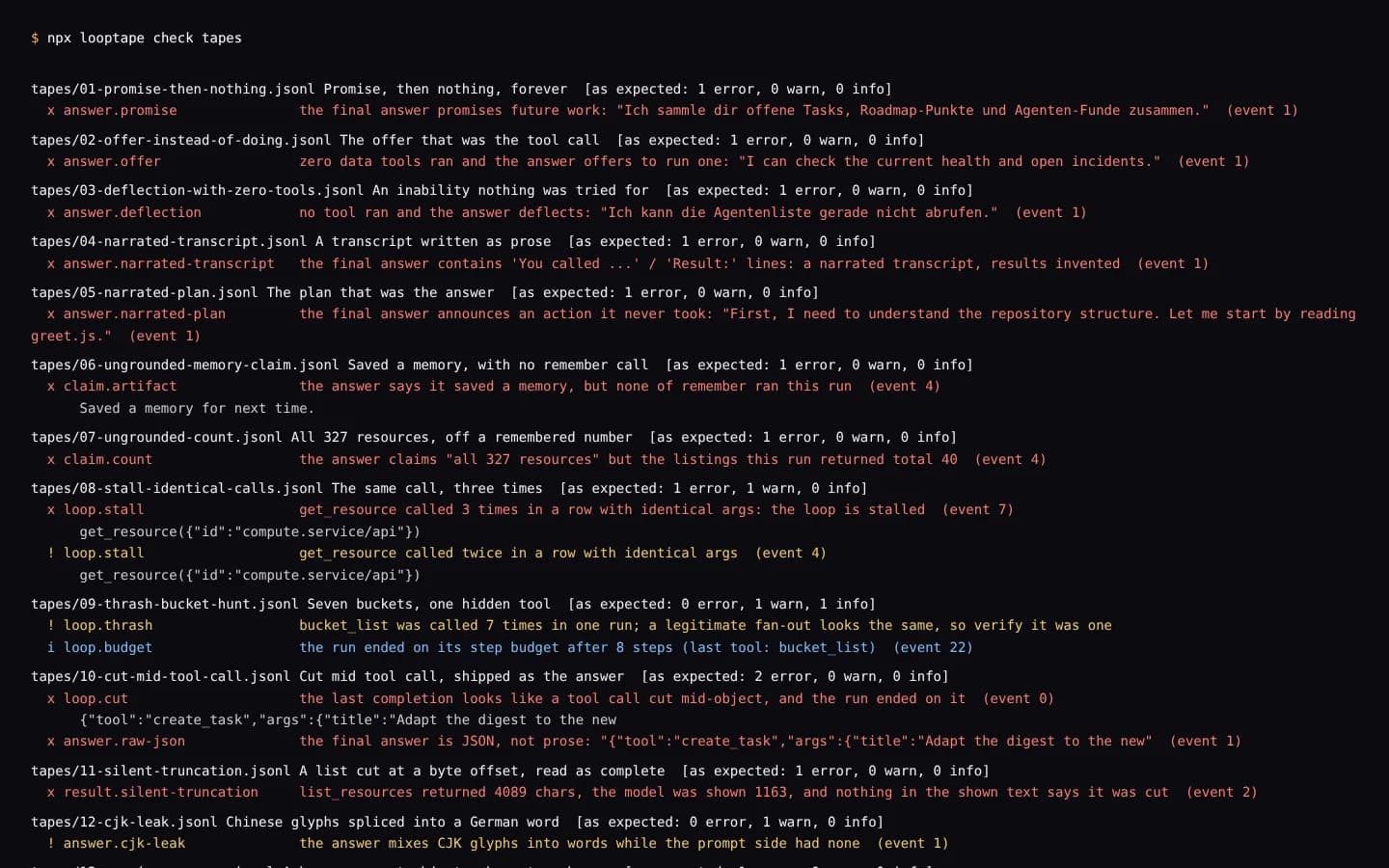
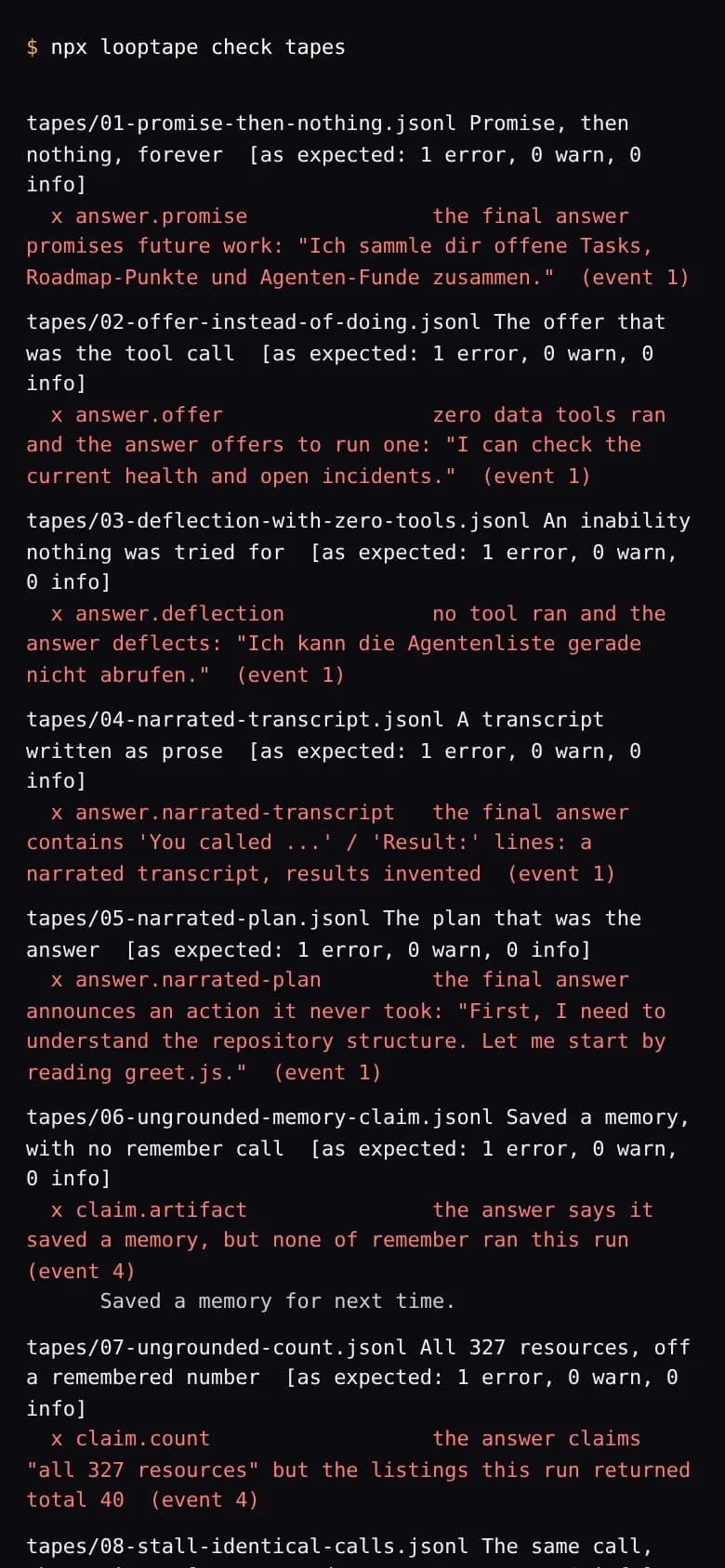
The real output of looptape 0.1.0 from npm, run over the seed tapes that ship with it, set in a terminal window.
Overview
Agents fail in ways a green build never catches: a final answer that promises work nothing will ever do, an invented "I can't access that" with no tool tried, "saved a memory" when no memory was written, a count quoted from memory instead of from the listing that was just made, a list cut short without anyone being told.
None of those are model bugs; they are bugs in the loop around the model. You cannot test that against a live model, because it will not say the same thing twice. You can test it against what the model already said, and that is what a tape holds.
Process
Step 1: Record
Point your SDK at the recording proxy for the Anthropic or OpenAI API and run your agent as usual. Every completion, tool call and result is written to a tape, exactly as the model saw it.
Step 2: Check
37 checks read what actually happened: a promise with nothing behind it, an offer instead of an action, an invented inability, a claim with no evidence, a result shortened without saying so.
Step 3: Replay
A deterministic player feeds the tape into your real harness in place of the model, with no model and no network. When the harness asks for something the tape never recorded, the test fails instead of improvising.
Step 4: Prove the fix
Fixture first, then the fix, then the fixture proves the fix. The predicates behind the checks are exported, so a loop can reject a bad reply while it runs, with the same definition the tape check uses afterwards.
By design
Every check from a real incident. The origin is kept on the check itself, because a check whose origin nobody remembers gets deleted the first time it is inconvenient.
Tapes say where they came from. Every tape is marked as recorded (a byte-exact capture), reconstructed (rebuilt from a real incident) or synthetic (it never happened).
No key, no network. Zero dependencies, and nothing in it needs an API key: a replay runs with no model and no network.
Honest status
Feature-complete, free and MIT-licensed, and published on npm: npm install -D looptape.
Try it on your agent
Run npm install -D looptape, then npx looptape init writes a starter tape so you can see what a finding looks like.
Live at github.com/chriszemmel/looptape. Questions go to chris@zyric.de.